
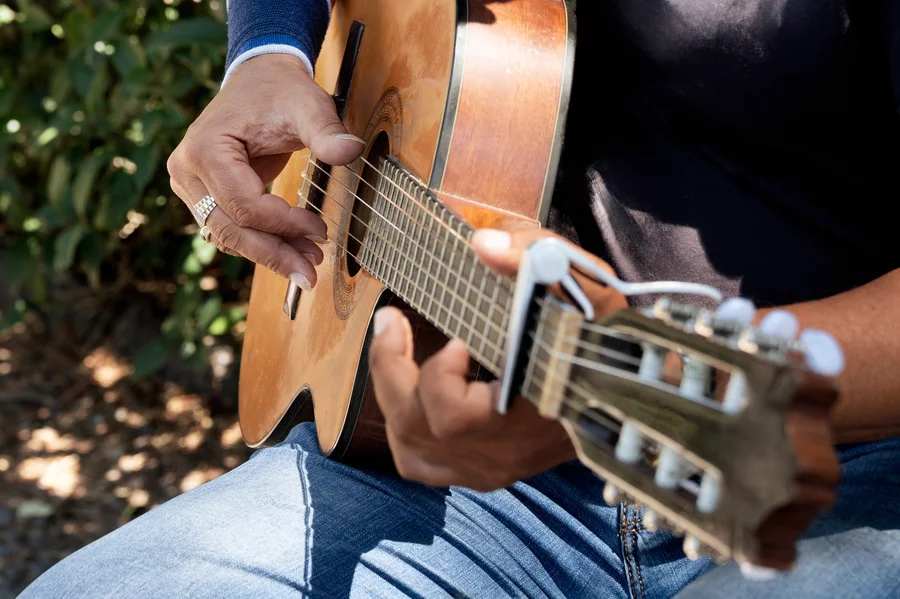
The best way to learn guitar for adults is structured, in-person lessons with a trained teacher, not endless YouTube videos. Adults bring discipline and motivation that kids don’t, and studies show it’s never too late to start.
- Learning guitar is challenging at first for every age; sore fingertips and clumsy chord changes are normal, not a sign you’re too old
- A Kyoto University study found older adults who kept practicing an instrument maintained memory and showed less brain shrinkage
- The golden rule: consistency beats intensity — 15 focused minutes daily outperforms a weekly two-hour cram session
- Many adults play simple songs in 2–3 months and strum confidently within 6–12 months
- Twin Cities School of Guitar offers a free introductory session to build your personal roadmap
Maybe you’ve had a guitar sitting in the closet since college. Maybe you just retired and finally have time for the thing you’ve always wanted to do. Whatever brought you here, we’ll tell you what we tell every student who walks through our doors: learning guitar as an adult isn’t just possible. It might be the best time in your life to start!
How Hard Is It to Learn Guitar as an Adult?
Let’s answer the question honestly, because you deserve better than empty hype. So, how hard is it to learn guitar as an adult? It’s challenging in the beginning, for everyone, at every age. Your fingertips will be tender for a few weeks. Chord changes will feel clumsy before they feel automatic. That’s not a sign you’re “too old.” That’s just what building new motor skills feels like.
Here’s what the science actually says. In a four-year study from Kyoto University, older adults who took up an instrument and kept practicing maintained their memory performance and showed less age-related brain shrinkage than those who quit, with benefits especially noticeable in brain regions tied to memory and learning. As the lead researcher put it, it’s never too late to start playing an instrument, and starting later in life may carry major benefits.
In other words, your brain is ready. The question is whether your approach will set you up to succeed.

What Is the Best Way to Learn Guitar for Adults?
The best way to learn guitar for adults is structured, in-person instruction with a trained teacher. Not a random playlist of YouTube videos, and not your buddy who “kind of knows some chords.”
Why? Because adults don’t fail at guitar from lack of talent. They fail from lack of direction. When it comes to guitar lessons, adults bring real advantages to the table: discipline, clear goals, life experience, and the ability to focus. What most adults don’t have is unlimited time. A qualified instructor builds a step-by-step plan around your goals, catches bad habits before they take root, and makes every practice minute count.
Not all guitar teachers are created equal, though. Great players aren’t automatically great teachers. Look for an instructor with real teaching training who can adapt to your goals (fingerstyle, blues, or strumming around a campfire) and who makes the process genuinely fun.
And if you’re wondering how to learn guitar as an adult when your schedule is already packed, that’s exactly what structure solves. A good teacher will show you how to make meaningful progress on 15 to 20 minutes of practice a day.
The Golden Rule of Learning Guitar as an Adult
If there’s one golden rule for anyone starting to play guitar, especially if you’re learning guitar as an adult, it’s this: consistency beats intensity. Fifteen focused minutes every day will take you further than a two-hour cram session on Sunday. Short, frequent practice is how your hands build the fine motor skills that make chords ring clean and changes feel effortless, and it’s how your brain locks in what you’ve learned.
Can You Get Good at Guitar as an Adult?
Absolutely, and the research backs it up. Harvard Health Publishing notes that music activates multiple areas of the brain, and that active musical engagement, including among adults over 50, is associated with higher rates of happiness and good cognitive function.
We see it in our studio every week. Learning to play guitar as an adult comes with a secret weapon kids don’t have: you actually want to be there. Nobody is making you take lessons. That motivation, paired with a proven plan, is a powerful combination.
So what is the best way for an older person to learn guitar? The same way it works for any adult, with a few smart adjustments. Choose a comfortable, well-set-up instrument (lighter strings and a properly adjusted neck make a huge difference for hands with a little arthritis or stiffness). Work with a patient teacher who tailors the pace to you. And learn songs you love from day one, because motivation is the engine that keeps you practicing.
How Long Does It Take for an Adult to Learn Guitar?
Every adult learns at a different pace, so think of these as typical milestones, not a schedule. With consistent practice and good instruction, many adults can play simple songs within their first two to three months. By six months to a year, many students strum confidently, switch between common chords smoothly, and play recognizable songs from start to finish. Reaching an intermediate level, with barre chords, basic lead playing, and more complex rhythms, typically takes one to two years of steady work.
Your timeline will depend on how often you practice and how efficiently you practice, which is exactly where a structured plan pays for itself. Students with a clear roadmap routinely progress two or three times faster than self-taught players who spend years wandering.
It’s Never Too Late to Start Learning Guitar as an Adult
Learning guitar as an adult isn’t about becoming a rock star (unless you want to be). It’s about proving to yourself that you can still learn something new, and having a blast doing it. Whatever limiting beliefs are holding you back (“my hands are too stiff,” “I have no rhythm,” “I should have started decades ago”), we’ve heard them all, and we’ve watched students shatter every one of them.
If you’re ready to finally learn the guitar the way you’ve always wanted, we’d love to help. Book your free introductory session at Twin Cities School of Guitar today, and let’s build your roadmap together.


